
On this page
Beyond the two big radiator hoses, your engine has a web of smaller coolant lines: heater hoses, bypass hoses, throttle body lines, turbo feed lines and reservoir hoses. Their joints use small clamps and plastic quick-connect clips that fail quietly. Route 66 Auto Repair in Upland traces a seep to the exact small joint and repairs the clamp, clip or O-ring there, with the fix written on your estimate.
Which small coolant joints leak most?
- Quick-connect fittings at the firewall and on plastic pipes
- Bypass hoses tucked under the intake or behind the engine
- Coolant lines to the throttle body on some engines
- Turbocharger coolant feed and return lines
- Hoses between the reservoir and the engine or radiator
How do quick-connect clips fail?
A quick-connect fitting pushes a hard pipe into a plastic socket. An O-ring inside does the sealing, and a clip or collar holds it in place. After years of heat, the clip loses its snap, the plastic collar cracks, or the O-ring shrinks. The joint can seep only under full pressure, leaving a dry crust you might not notice until the reservoir runs low.
Many clips are only sold with the hose, which is why the fix is sometimes a hose, not just a clip. We explain that on the estimate. For the large upper and lower hoses, see radiator hose clamp replacement.
Our small hose joint repair process
Step 1: Trace under pressure
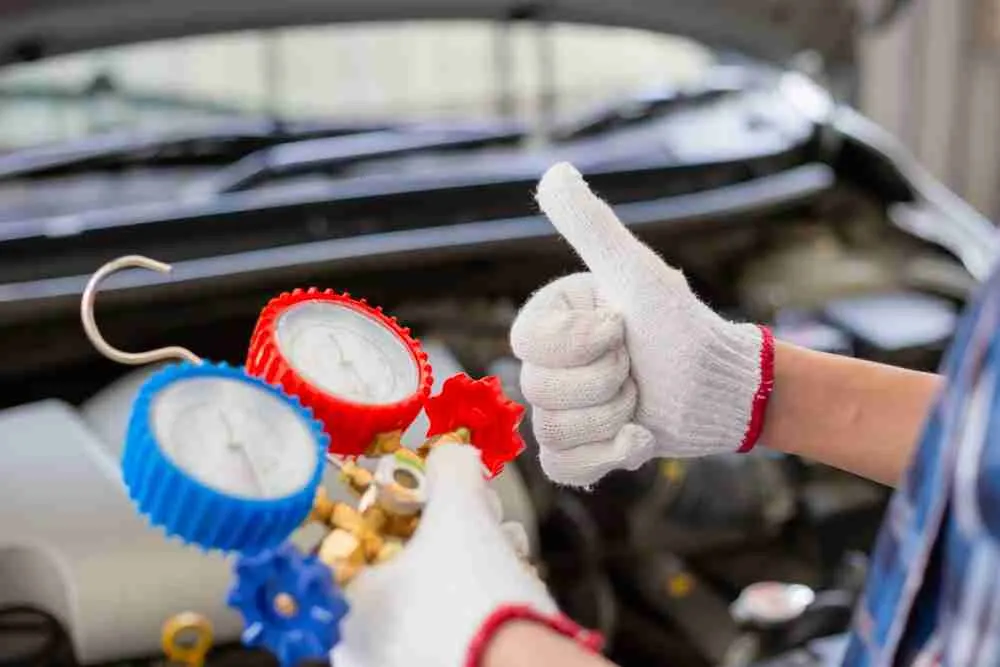
The system is pressurized and each small joint is checked with a light and mirror, including hard-to-see spots.
Step 2: Choose the repair
We decide whether a clamp, a clip, an O-ring or the hose with its fittings is the right fix, and quote that.
Step 3: Repair
The joint is released, cleaned, fitted with new parts and locked, with a pull test on quick-connects.
Step 4: Refill and recheck
Coolant is topped up and bled, and the joint is checked again at operating temperature.
What's included in coolant hose clamp repair
Included on the work order
- 01Pressure test with a joint-by-joint check
- 02New clamp, clip, collar or O-ring at the failed joint
- 03Hose with fittings when clips are not sold separately
- 04Coolant top-off and air purge
- 05Pull test and hot recheck of the repaired joint
Does a small seep need fixing now?
Need now: call
- A quick-connect that has popped partly out
- Coolant dripping onto a hot exhaust or turbo
- Reservoir dropping between fills
Need later: book
- Dry crust at a clip with a steady level
- An aged hose noted during other work that still holds pressure
How pricing and timing work
Access is the big variable. A reservoir hose is usually in plain sight. A bypass hose under the intake manifold can mean removing the manifold, and the estimate lists those gaskets too. The diagnostic fee is stated at the counter before testing and applies to approved related repair. Simple joints are usually done the same day when the board allows.
After the repair
Check the reservoir cold for several mornings. On turbo engines, a coolant smell after a hard run is worth a call. If you keep finding low coolant with no drip, a coolant system leak detection visit can look deeper. You can also reach us at (909) 646-4111.
Frequently asked questions
Can a zip tie hold a loose quick-connect?
No. It will not hold against system pressure and heat for long, and the O-ring still has to seal. Replace the clip or the hose.
Why is the leak only visible with the engine hot?
Pressure is highest when the coolant is hot, and plastic fittings expand. A worn O-ring can seal cold and seep hot.
Do small hoses need the same coolant bleed as a big job?
Any time the system is opened, some air can get in. We purge it the way your engine requires, even on a small repair.