
On this page
Route 66 Auto Repair in Upland fixes car air conditioning that blows warm, heaters that stay cold, and engines that run hot. We find the cause before we sell a part: vent temperature readings, gauge pressures, a leak test before any recharge, and a pressure test on the cooling system. ASE-certified technicians do the work at 1775 W Foothill Blvd, and you get a written estimate before any repair starts.
Why is my AC cold on the freeway but warm in traffic?
This is one of the most common complaints we hear in Upland, and it usually points to heat that is not leaving the car. Your AC moves heat from the cabin to the condenser, the radiator-like panel in front of the engine radiator. At 65 mph on the 210, air is forced through the condenser for free. Parked at a light on Foothill Blvd, the only airflow comes from the electric fan behind it.
So when the air turns lukewarm in stop-and-go and cools off again once you pick up speed, we look first at the condenser fan, its relay and its command from the engine computer. A condenser packed with bugs, road grime or bent fins does the same thing. A system that is slightly low on refrigerant can also show this pattern, which is why we measure instead of guessing.
Why do you leak test before an AC recharge?
An AC system is sealed. If the level is low, it leaked out somewhere, and it will leak out again. A recharge alone puts back what escaped and sends you home with the same hole. Then you pay twice.
So before we charge a system, we check for the leak. Depending on the car, that means UV dye and a black light, an electronic leak detector that sniffs for refrigerant, and a vacuum or standing pressure test that shows whether the system holds. Common spots are the condenser, hose crimps, service port valves, the compressor shaft seal and the evaporator behind the dash.
Used a parts-store can with sealer? Tell us at intake. Sealer can clog small passages in your system and in our recovery equipment, so it changes how we test.
How do we test AC performance?
We start with a baseline: outside temperature, humidity and center vent temperature, read with a probe thermometer at set engine speeds with the doors closed.
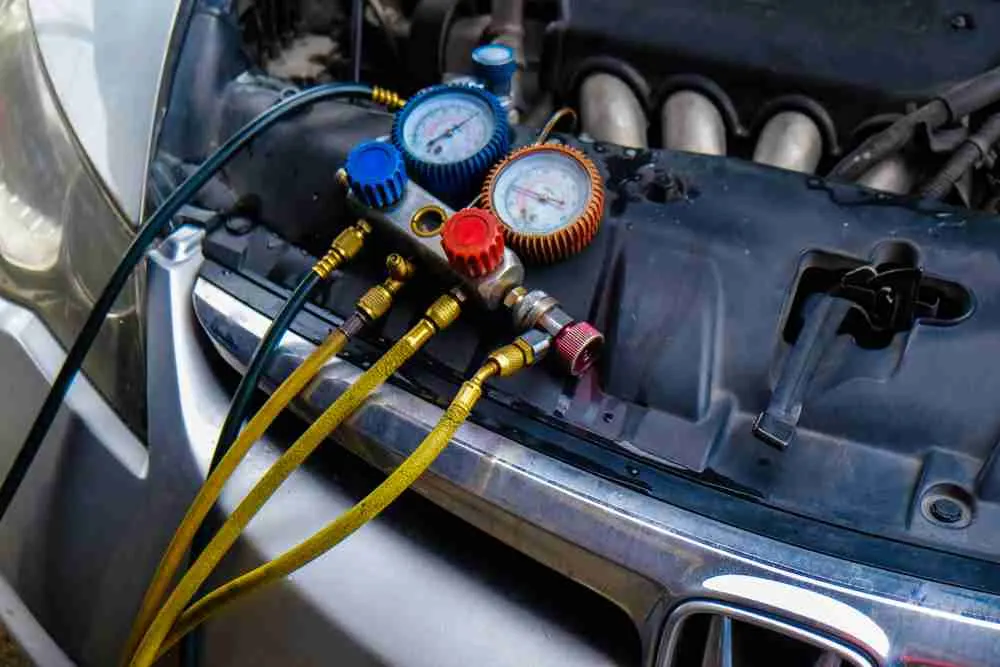
Then gauges go on the high and low side service ports. Pressures are read against ambient temperature, because a reading that is fine on a mild morning is wrong on a 105-degree afternoon in the Inland Empire. Both sides low points to undercharge. A high side that climbs at idle points to airflow at the condenser. A low side that drops too far and frosts can point to a restriction or an expansion valve problem.
We also scan the climate and engine modules. Many cars read the high side pressure with a sensor and will refuse to engage the compressor if that reading is off. A bad sensor can look like an empty system. Our car AC repair page explains the repair side.
Why is my heater not blowing hot air?
Your heater has no burner. It borrows heat from engine coolant, which flows through the heater core, a small radiator inside the dash. If heat is weak, we first check coolant level, trapped air and whether the engine reaches normal temperature. A thermostat stuck open keeps the engine cool on the highway and leaves you with lukewarm air on a cold morning in the foothills.
Next come the blend doors. These are flaps inside the dash, moved by small electric motors called actuators, that mix hot and cold air and send it to the floor, dash or windshield. A clicking sound behind the glovebox, heat on one side only, or air that comes out the wrong vent all point to a door or actuator.
If coolant is full and the doors move, we feel both heater hoses. One hot and one cool means flow through the core is poor. A sweet smell inside the car, a greasy film on the windshield or damp carpet on the passenger side points to a leaking heater core.
What should you do if your engine starts to overheat?
Do not keep driving a climbing temperature needle. Turn the AC off and turn the heater to full hot to pull some heat away from the engine. If the needle keeps rising, pull over where it is safe, shut the engine off and call us at (909) 646-4111. Never open a hot radiator cap or coolant tank. The coolant is under pressure and can burn you.
A few more miles on a hot engine can turn a hose failure into a warped cylinder head. We accept tow-ins.
Why do we pressure test the cooling system before replacing parts?
Coolant can disappear without leaving a puddle. It can drip onto a hot exhaust and steam away, seep from a water pump into the timing cover, or leak past a head gasket into the cylinders.
A cooling system pressure test fixes that. We fit a hand pump to the radiator or tank neck and bring the system to its rated pressure with the engine cool, then watch the gauge and look for drips at hoses, the radiator, the water pump and the heater core connections. We test the cap on its own adapter, because a weak cap lets coolant boil early. When we suspect a head gasket, a combustion gas test on the coolant adds another piece of evidence.
If you want a full look without a symptom yet, book a cooling system inspection. It is smart before summer or a long trip.
Which cooling system parts fail most?
Thermostat
The thermostat is a heat-sensitive valve that stays closed until the engine warms up, then opens to send coolant to the radiator. Stuck closed, it overheats the engine quickly. Stuck open, the engine runs cool, the heater stays weak and fuel economy drops.
Radiator
Radiators leak at plastic end tanks, clog inside with scale and old coolant, or lose airflow when fins are packed with debris. Age and heat cycles crack the tanks. Our radiator repair page covers when we clean, when we replace and why patching a plastic tank rarely lasts.
Cooling fans
Electric fans pull air through the radiator and AC condenser when the car is slow. A failed fan motor, relay, fuse or temperature signal shows up as overheating in traffic that clears on the freeway. Older trucks use a belt-driven fan with a viscous clutch that wears and slips.
Hoses and clamps
Rubber hoses soften, swell and crack from the inside. A hose that feels spongy or crunchy when squeezed cold is near its end. Brittle plastic fittings on newer cars can snap during service, so we price them in when we see them.
Water pump
The water pump circulates coolant. Watch for a drip from the weep hole, a wobble in the pulley, or a whine. Some pumps are driven by the timing belt or chain, which changes the job a lot. See water pump repair for details.
How does Inland Empire heat affect your cooling and AC?
Summer here asks a lot of a car. Afternoon temperatures push past 100 degrees, and the pavement on Foothill Blvd is hotter still. Your AC works hardest when the outside air is hottest, and your radiator has the least cooling margin at the same moment.
Grades add load. Climbing the Cajon Pass on the 15, or the 57 through the hills, makes the engine produce more heat while the car may be crawling in traffic. Stop-and-go on the 10 and the 210 takes away the ram air your radiator and condenser depend on. Dust clogs fins, and coolant that never gets changed turns acidic.
Towing in heat is the hardest test of all. If you are pulling a trailer or a rental this summer, book a mechanical check of your tow vehicle first, and ask about our free towing inspection, which is a hookup check of the hitch, chains and lights. The cooling, brake and transmission check on your own vehicle is a normal paid inspection.
What do common AC, heater and cooling symptoms usually mean?
Use this as a starting point, not a diagnosis.
| Symptom | Likely causes | What we check first | Urgency |
|---|---|---|---|
| AC cold on the freeway, warm at idle | Condenser fan, blocked condenser, low charge | Fan command and operation, high side pressure at idle | Can be scheduled |
| AC blows warm all the time | Leak, clutch not engaging, pressure sensor, blend door | Compressor engagement, gauge readings, scan data | Can be scheduled |
| AC cold, then warm after a long drive | Evaporator icing, moisture in system, temperature sensor | Low side pressure over time, evaporator temperature reading | Can be scheduled |
| Loud grind or squeal with AC on | Compressor, clutch or pulley bearing | Stethoscope check, clutch air gap, belt path | Soon, a seized pulley can throw the belt |
| No heat or weak heat | Low coolant, thermostat open, clogged heater core, blend door | Coolant level, engine temperature, heater hose temps | Soon if the windshield will not clear |
| Sweet smell or foggy windshield | Heater core leak | Pressure test, carpet and case drain check | Soon, it affects visibility |
| Temperature needle climbing | Low coolant, fan, thermostat, water pump, head gasket | Pressure test, fan operation, combustion gas test | Now, pull over and call |
Our cooling, heating and AC repair process
Step 1: Listen and record
The service writer notes when the problem happens: at idle, on grades, after a long drive, first thing in the morning. Those details save test time.
Step 2: State the diagnostic fee
The counter tells you the diagnostic fee before testing starts. It applies to approved related repair.
Step 3: Measure
We take vent temperatures, gauge pressures, scan data and a cooling system pressure test as the symptom calls for.
Step 4: Find the leak or failed part
Dye, an electronic detector or a standing test locate leaks. We photograph the failed part when the part is the point.
Step 5: Written estimate
You get a written estimate with each line marked need-now or can-wait. If the job grows, we stop and ask again.
Step 6: Repair and verify
We repair to spec, charge AC by weight to the amount your vehicle specifies, then run a quality check and a road test with vent and engine temperatures recorded.
What's included in a cooling or AC visit
Included on the work order
- 01Symptom interview and written repair order
- 02Center vent temperature reading against outside temperature
- 03High and low side gauge readings and module scan
- 04Leak test before any refrigerant is added
- 05Cooling system and radiator cap pressure test when coolant is involved
- 06Photos of failed parts when they explain the repair
- 07Written estimate with need-now and need-later lines
- 08Quality check and road test after the repair
Is it a need-now or need-later repair?
Need now: call
- Engine running hot or losing coolant fast
- Heater core leak that fogs the windshield
- Seizing compressor or pulley that could throw the drive belt
- Swollen or cracked radiator hose
Need later: book
- AC slightly weak on the hottest afternoons
- Musty smell from the vents
- Minor seepage that holds on a pressure test
- Coolant that is due for a change but tests OK
How pricing and timing work
Timing depends on the board. A leak test and recharge or a thermostat is often same-day when the board allows, so call before you drive over. Jobs that pull the dash or need a system flush take longer, and we tell you the look window at drop-off. If it will slip, we text you. Wait or drop-off is decided at intake.
What to expect after the repair
After an AC repair, run the system at least once a week, even in winter. Change the cabin air filter on schedule. If the air warms up again, come back: comebacks go to the front of the line and the root cause is written on the repair order.
After a cooling repair, check the coolant level cold for the first few days and look under the car where you park. A steady drop, a sweet smell or a rising needle means call us at (909) 646-4111. Warranty coverage depends on the part and repair and is written on your invoice.
Every cooling, heating and ac services page
Each page explains the symptoms, how we test, what the work order includes and what to ask before you approve.
- Cooling System Services Overview
- Car AC Repair
- AC Compressor Replacement
- Refrigerant Recharge
- Evaporator Coil Cleaning
- AC Condenser Repair
- Heater Core Service
- AC System Flush
- AC Clutch Repair
- AC Pressure Switch Replacement
- AC Expansion Valve Repair
- AC Evaporator Replacement
- AC Condenser Fan Repair
- AC System Leak Detection
- Heater Blower Motor Repair
- AC Compressor Clutch Replacement
- AC Line Repair
- AC System Recharge
- Heater Control Valve Repair
- AC Dryer Replacement
- AC System Pressure Testing
- Heater Core Flush
- AC Thermostat Replacement
- AC Hose Replacement
- AC Compressor Bearing Repair
- AC System Diagnostic
- Heater Fan Motor Replacement
- AC Condenser Seal Repair
- AC Evaporator Core Replacement
- AC System Filter Replacement
- Heater Core Hose Repair
- AC Clutch Bearing Replacement
- AC System Vacuum Test
- AC Pressure Regulator Repair
- Heater Control Module Repair
- AC System Performance Test
- AC Compressor Pulley Repair
- AC System Retrofit
- Heater Core Bypass Repair
- AC Expansion Valve Cleaning
- AC Condenser Coil Cleaning
- AC System Insulation Repair
- Heater Blower Resistor Repair
- AC Compressor Oil Change
- AC System Decontamination
- Heater Core Valve Replacement
- AC Line Insulation Repair
- AC System Flush Valve Repair
- Heater Core Seal Repair
- AC Compressor Seal Replacement
- AC System Temperature Sensor Repair
- Radiator Repair
- Radiator Flush
- Coolant Leak Repair
- Radiator Cap Replacement
- Thermostat Housing Repair
- Cooling Fan Service
- Radiator Pressure Testing
- Radiator Hose Replacement
- Coolant System Service
- Radiator Core Replacement
- Cooling System Flush
- Radiator Fan Motor Repair
- Coolant Reservoir Replacement
- Radiator Seal Repair
- Cooling System Pressure Test
- Radiator Fin Repair
- Coolant System Bleeding
- Radiator Thermostat Replacement
- Cooling Fan Blade Replacement
- Radiator Overflow Tank Repair
- Coolant System Diagnostic
- Radiator Mounting Repair
- Cooling System Hose Replacement
- Radiator Fan Relay Repair
- Coolant System Leak Detection
- Radiator Support Repair
- Cooling System Inspection
- Radiator Drain Plug Repair
- Coolant System Seal Replacement
- Radiator Fan Clutch Repair
- Cooling System Thermostat Valve Repair
- Radiator Hose Clamp Replacement
- Coolant System Flush Valve Repair
- Radiator Core Support Repair
- Cooling System Pressure Regulator Repair
- Radiator Fan Motor Replacement
- Coolant System Hose Clamp Repair
- Radiator Overflow Hose Repair
- Cooling System Temperature Sensor Repair
- Radiator Fan Shroud Repair
- Coolant System Air Purge
- Radiator Mounting Bracket Repair
- Cooling System Radiator Cap Test
- Radiator Hose Pressure Testing
- Coolant System Contamination Test
- Radiator Fan Switch Repair
- Cooling System Fluid Analysis
- Radiator Core Cleaning
- Coolant System Pressure Valve Repair
- Radiator Fan Belt Replacement
- Thermostat Replacement
Videos from the shop
Frequently asked questions
Why is my car AC blowing hot air?
The usual causes are a leak that let the refrigerant out, a compressor clutch that is not engaging, a failed pressure sensor, or a blend door stuck on heat. We check compressor engagement, read gauge pressures and scan the modules before recommending any part, so you pay for the fix and not a guess.
Can you just recharge my AC?
We can, but we leak test first. A system that is low has a leak, and a recharge without finding it usually fails again within days or weeks. If you choose to recharge and monitor a slow leak, we note that on the repair order.
Why is my car overheating?
Common causes are low coolant from a leak, a thermostat stuck closed, a cooling fan that is not running, a failing water pump or a clogged radiator. We pressure test, check the fans and test for combustion gas before naming a cause.
Is it safe to drive with the temperature gauge rising?
No. Turn off the AC, set the heater to full hot, and if the needle keeps climbing, pull over safely and shut the engine off. Do not open the radiator cap while hot. Call us at (909) 646-4111.
Where does coolant go when there is no puddle?
It can evaporate off hot exhaust parts, leak into the cabin through the heater core, or burn inside the engine through a head gasket. A cooling system pressure test with the engine cool, plus a combustion gas test when needed, shows which one it is.
Why is my car heater not blowing hot air?
Check the coolant level first. After that, the common causes are a thermostat stuck open, air trapped in the system, a partly clogged heater core or a blend door that will not move. We measure engine and heater hose temperatures and command the doors with a scan tool.
Do you work on hybrid AC systems?
Many hybrids use an electric compressor with special oil and high voltage wiring. Tell us it is a hybrid at intake and we will explain what we can take on for your vehicle before any work starts.