

On this page
The AC condenser sits at the very front of your car, which makes it the first part to take a rock on the 10. Route 66 Auto Repair in Upland tests condensers for leaks and blocked airflow, then tells you honestly whether cleaning, a seal or a new condenser makes sense. Most damaged condensers are replaced, not patched, and your written estimate shows why.
What does the AC condenser do?
Hot, high-pressure refrigerant leaves the compressor and flows through the condenser's thin tubes and fins. Air passing over them strips the heat, and the refrigerant turns from gas to liquid. If air cannot get through, or refrigerant leaks out, that heat stays in the system and the vents warm up. You notice it first when you slow down, since highway speed forces extra air through the fins.
How do condensers fail?
- Stone or debris punctures a tube, often with an oily dye stain nearby
- Corrosion eats the aluminum where road salt or coastal air reaches it
- Leaves, bugs and dust pack the fins and block airflow
- A minor front-end bump bends the core or cracks a fitting
- Internal passages clog after a compressor failure
Can a condenser be repaired?
Sometimes. A leaking O-ring at an inlet or outlet fitting is a seal job, covered on our condenser seal repair page. Packed fins can be cleaned, which is its own service called condenser coil cleaning. A hole in the core is different. The tubes are thin, flat and tightly packed, and patches seldom hold under high side pressure. We replace the core in those cases and say so plainly, often with the drier, because many condensers have the drier built in.
Our condenser process
Step 1: Look and sniff
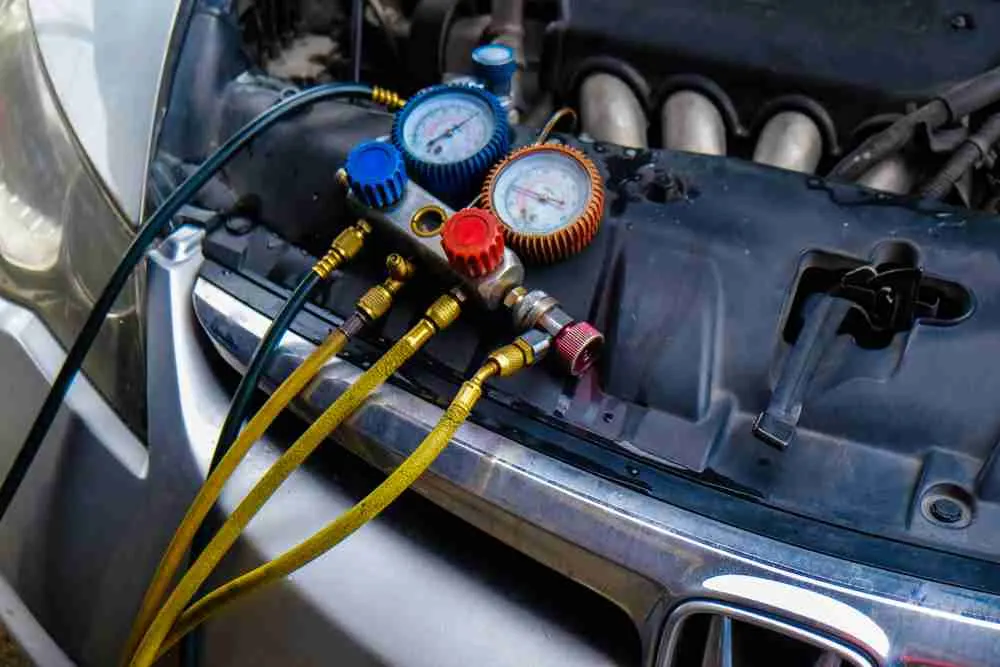
We inspect the face for damage and use an electronic detector along the tubes.
Step 2: Check airflow
High side pressure at idle with the fan running shows whether heat is leaving.
Step 3: Replace or reseal
The condenser or fitting seals are replaced with new O-rings and correct oil.
Step 4: Vacuum, charge, road test
The system is evacuated, charged by weight and tested at idle and speed.
What's included in AC condenser repair
Included on the work order
- 01Leak and damage inspection with photos
- 02Refrigerant recovery
- 03Condenser or fitting seal replacement
- 04Integrated drier or desiccant bag when applicable
- 05Evacuation and charge by weight
- 06Idle and highway performance check
How pricing and timing work
On some cars the condenser comes out from below in an hour or two. On others the bumper cover has to come off. Your estimate reflects that labor, the part and the refrigerant. Most condenser jobs finish in a day when parts are in stock and the board allows. If a front-end impact also bent the radiator, we tell you before we start. See car AC repair for the wider system.
Frequently asked questions
Can stop-leak fix a condenser hole?
It rarely holds on a puncture, and sealer can clog the expansion valve and contaminate recovery equipment. Replacing the damaged condenser is the lasting fix.
Should I add a grille screen?
A fine screen can reduce rock hits, but it also blocks some airflow. If you tow or climb grades in summer, keep the radiator and condenser airflow open and inspect the fins instead.
Is a condenser leak an emergency?
No. It is a comfort issue unless the leak is from a crash that also damaged the radiator. You can schedule it, though the AC will not cool until it is fixed.