
On this page
If your brakes are grinding, squealing, pulsing or sinking toward the floor, Route 66 Auto Repair in Upland can find out why and fix it. Our ASE-certified (opens in a new tab) technicians measure your pads and rotors, check the fluid and hoses, and road-test the car. You get a written estimate that marks every line as need-now or need-later before any work starts. We are on Foothill Blvd at Central Ave, between the I-10 and the 210.
Grinding, squealing, pulsing or a soft pedal: what is your car telling you?
Brake noises are unnerving because you cannot see what is wrong, and you still have to drive home. The good news is that each sound or feeling points somewhere fairly specific. Use this table to judge how fast you need to act, then let us confirm it with a measurement. Grinding and a soft pedal are the two you should not keep driving on.
Squeal is the one that fools people. Many pads squeak a little on a cool, damp morning and go quiet after a few stops. A squeal on nearly every stop, even once the brakes are warm, is usually the metal wear tab touching the rotor. It is designed to be annoying so you book the visit before the pads reach metal.
| What you notice | Likely cause | Need it now or later? |
|---|---|---|
| Grinding, metal on metal, when you stop | Pad lining is gone and the steel backing plate is cutting into the rotor | Now. Stopping distance grows and rotor damage spreads with every mile. |
| High-pitched squeal on most stops | Pad wear tab touching the rotor, or a glazed pad face | Soon. Book within days if it is the wear tab; glazing can often wait. |
| Pulsing pedal or steering wheel shake | Uneven rotor thickness, often from heat on long downhill runs, or loose parts | Later in most cases. Sooner if the shake is strong at freeway speed. |
| Soft or sinking pedal | Air or moisture in the fluid, a leaking line or hose, or a worn master cylinder | Now. Do not drive far. Call us or arrange a tow. |
| Car pulls to one side when braking | Sticking caliper or slide pin, a restricted hose, or uneven pad wear | Now. A dragging brake overheats and can fade. |
| Amber ABS light on | Wheel speed sensor, sensor wiring, tone ring or the anti-lock module | Soon. Normal braking usually still works. |
| Red BRAKE light on | Low fluid, a hydraulic fault or the parking brake still set | Now, unless releasing the parking brake turns it off. |
| Burning smell after a drive | Dragging caliper, parking brake partly on, or new pads curing | Now if one wheel is much hotter; later if the pads are brand new. |
How do we measure brake pads and rotors?
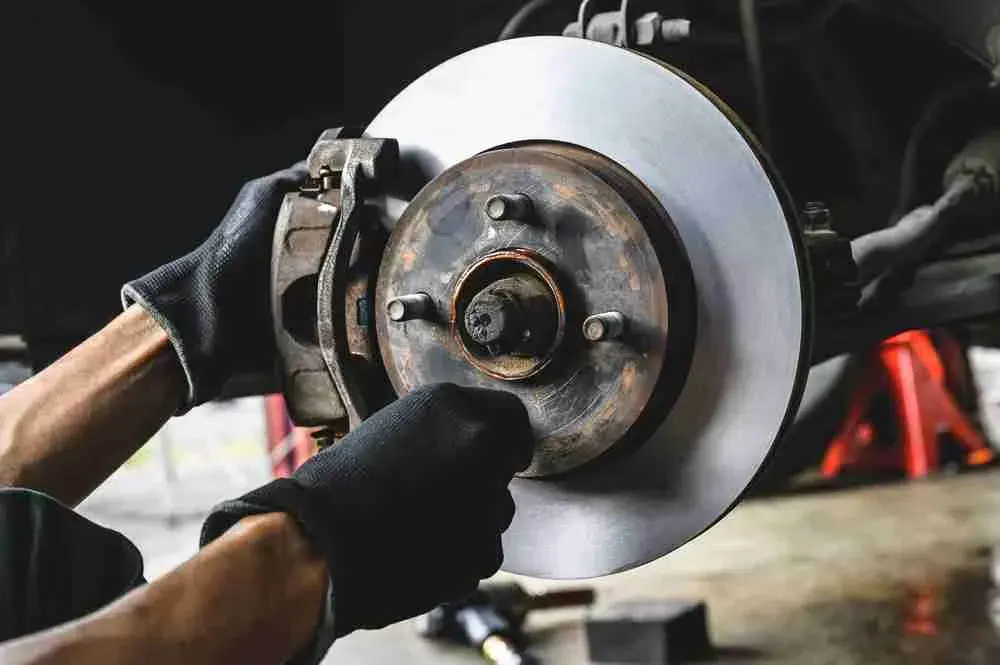
We do not judge brakes by a glance through the wheel spokes. With the wheels off, the technician measures the pad lining on both the inner and outer pad at each wheel. The inner pad is the one you cannot see, and it often wears faster when a slide pin sticks. Those readings go on your repair order so you can compare them next time.
Rotors get a micrometer reading at several points around the braking face. Every rotor has a minimum thickness cast or stamped into it, usually on the center hat or the outer edge, often marked MIN TH or DISCARD. If the rotor is at or near that number, it cannot be resurfaced, because cutting it would take it below the safe limit. A thin rotor holds less heat, so it fades and shakes sooner.
We also check runout, which is how much the rotor wobbles as it spins, and we look for heat cracks, blue spots and a raised lip at the outer edge. When the worn part is the point of the conversation, we take photos, so you see what we saw, and old parts can be shown at pickup.
It helps to know the scale those readings sit on. A new brake pad usually leaves the box with somewhere around 10 to 12 millimeters of friction material, and widely published service guidance treats roughly 3 millimeters, about an eighth of an inch, as the point to plan a replacement. A rotor has no mileage figure at all: it is judged against the minimum thickness cast into the part. Those are general industry reference points, not promises. The specification your vehicle maker publishes is the one your repair order is measured against.
Should you replace just the pads, or pads and rotors?
This is the question we hear most at the counter, and the honest answer is that the measurement decides. Pads-only makes sense when the rotors are above minimum thickness, run true, and have a smooth face without deep grooves. There is no reason to sell you rotors you do not need.
Pads and rotors together makes sense when the rotors are at or near the discard number, when the old pads wore into metal, when you can feel a pulsation, or when resurfacing would leave too little material. Many newer cars leave the factory with thin, light rotors, so there is often not much metal to spare. If we recommend new rotors, the estimate says why in plain words, and you see the reading next to the spec before you decide.
Why does brake fluid wear out?
Brake fluid slowly pulls moisture from the air, even through a closed system. Water lowers the fluid's boiling point. On a long, hot descent like the Cajon Pass, fluid with water in it can boil inside a caliper, and the pedal goes soft right when you need it most. Water also corrodes steel lines, caliper bores and the small valves inside the anti-lock unit.
We test fluid condition instead of guessing by color. When it is due, a brake fluid flush replaces the old fluid with the type your vehicle specifies and bleeds each wheel in order. Your owner's manual lists the interval, and summer stop-and-go on Foothill Blvd does nothing to stretch it.
What does the ABS light mean?
ABS stands for anti-lock braking system. In a hard stop it pulses the brakes so the wheels keep turning and you can still steer. When the amber ABS light stays on, the system has found a fault and switched itself off. Your regular brakes usually still work, but you lose that anti-skid help on wet pavement or in a sudden stop, and often traction and stability control with it.
The usual causes are a wheel speed sensor, a damaged sensor wire near the hub, a rusted tone ring or low battery voltage. Less often it is the pump or the control module. We read the codes, watch live wheel speed data on a road test, and test the wiring before we name a part. If the red BRAKE light is on too, treat it as urgent.
Is your parking brake really holding?
Upland sits on a slope, and a parking brake that only half holds is a real problem in a steep driveway north of Foothill Blvd. Many rear disc setups use a small drum brake inside the rotor hat for parking. Others use a screw mechanism inside the rear caliper. A lot of newer cars have an electronic parking brake with a motor on each rear caliper, which must be opened with a scan tool before any pad work.
Signs of trouble include a lever or pedal that travels farther than it used to, a car that creeps on a hill, a parking brake warning message, or a rear wheel that drags after release. Cables stretch and rust, shoes wear, and electronic units fault out. We test the parking brake hold on every brake inspection.
Our brake repair process, step by step
Step 1: Listen and write it down
At the counter we note what you hear and feel, when it happens and how long it has been going on. You choose wait or drop-off at intake.
Step 2: Road test first
A technician drives the car to reproduce the noise, pull or pulsation before anything comes apart.
Step 3: Measure and inspect
Wheels come off. We measure pads and rotors, check calipers, slide pins, hoses, lines and fluid, and photograph anything worn or failed.
Step 4: Written estimate
Each line is marked need-now or need-later. Nothing extra happens without your approval, and if the job grows, we stop and ask again.
Step 5: Repair to spec
Parts go on to the manufacturer's specification, including torque on caliper bolts and lug nuts. If two technicians are needed on your job, we explain that before the clock starts.
Step 6: Quality check and road test
The work is checked a second time, then road-tested to confirm the pedal, the stop and the noise. Declined items stay on the repair order as a record.
What's included in a brake job at Route 66 Auto Repair
Included on the work order
- 01Road test before and after the repair
- 02Pad and rotor measurements recorded on the repair order
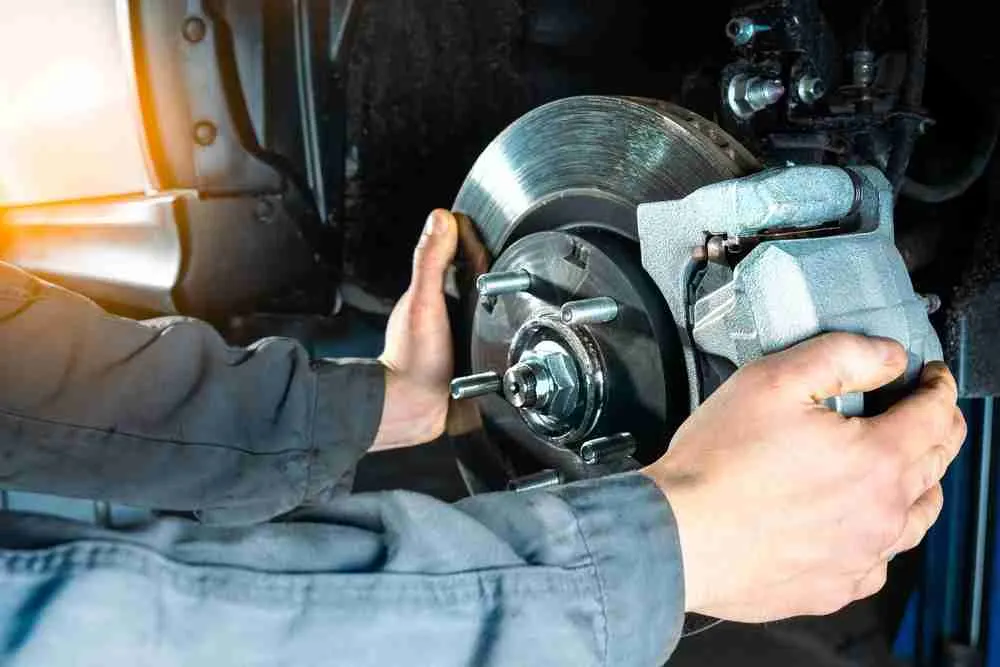
- 03Caliper, slide pin and hardware inspection
- 04Brake hose, line and fluid condition check
- 05Parking brake hold test
- 06Photos of worn or failed parts, with old parts available to see
- 07Written estimate with need-now and need-later labels
- 08Lug nuts torqued to specification
Which brake repairs are need-now and which can wait?
Need now: call
- Grinding noise, or pads worn down to the backing plate
- A soft, sinking or unusually low pedal
- Fluid leaking from a line, hose or caliper
- A pull under braking or a red brake warning light
Need later: book
- Pads with life left, noted with the reading so you can plan
- Mild rotor pulsation you feel only in hard stops
- Brake fluid that tests near its limit but not past it
- A parking brake that needs adjusting but still holds
How do pricing and timing work for brake repair?
We do not quote a flat brake price over the phone, because two cars with the same squeal can need very different work. What changes the price: the vehicle, one axle or both, pads only or pads and rotors, the parts grade you choose, whether calipers or hardware are seized, and whether an electronic parking brake needs a scan tool. Phone quotes are ranges until we see the car. After the inspection, you get a written estimate, and that is the number we work from.
Timing depends on the board, which is our schedule for the day. Many pad jobs can be done same-day when the board allows, so call (909) 646-4111 before you drive over. If parts are not on the shelf, we say so up front, and if the time we gave you is going to slip, we text you.
How do brakes, tires and suspension affect each other?
A car that pulls or shakes under braking is not always a brake problem. A worn tire, low pressure, or a loose tie rod can feel just like a sticking caliper. While the wheels are off, we look at tire tread and condition and at suspension and steering parts. Wheel alignment is not done in-house; if a pull points to alignment, we arrange it and road-test the result.
Not sure anything is wrong yet? A brake system inspection gives you real measurements before a road trip, a move with a loaded trailer, or right after you buy a used car.
What should you do after a brake job?
New pads need bedding in. For the first few days, make smooth, moderate stops and avoid long, hard braking, such as riding the pedal down a grade. This lays a thin, even film of pad material onto the rotor face, which gives you a quieter, stronger stop and helps prevent judder later.
A faint hot smell on the first few drives is normal while coatings cure. A pedal that feels different, a new noise or a pull is not. Call us and come back. Comebacks go to the front of the line, and the root cause is written on the repair order. Warranty coverage depends on the part and the repair, and it is written on your invoice.
Every brake services page
Each page explains the symptoms, how we test, what the work order includes and what to ask before you approve.
- Brake Services Overview
- Brake Repair
- Brake Service
- Brake Pad Replacement
- Brake Rotor Resurfacing
- Brake Rotor Replacement
- Brake Caliper Replacement
- Brake Caliper Rebuilding
- Brake Caliper Piston Repair
- Brake Caliper Bolt Replacement
- ABS System Diagnostics
- ABS System Repair
- ABS Module Repair
- ABS Pump Repair
- ABS Sensor Replacement
- ABS Wheel Speed Sensor Repair
- ABS Control Unit Diagnostics
- Anti-Lock Brake Repair
- Brake Line Repair
- Brake Line Flushing
- Brake Line Pressure Testing
- Brake Line Corrosion Repair
- Brake Line Fitting Replacement
- Brake Hose Replacement
- Brake Hose Clamp Replacement
- Brake Fluid Flush
- Brake Fluid Testing
- Brake Fluid Contamination Testing
- Brake Fluid Leak Detection
- Brake Fluid Reservoir Replacement
- Brake System Bleeding
- Brake System Inspection
- Brake System Pressure Adjustment
- Parking Brake Adjustment
- Parking Brake Service
- Parking Brake Cable Repair
- Parking Brake Lever Repair
- Emergency Brake Repair
- Emergency Brake Shoe Replacement
- Brake Shoe Replacement
- Brake Drum Repair
- Brake Drum Resurfacing
- Brake Disc Replacement
- Brake Hardware Repair
- Brake Pad Sensor Replacement
- Brake Pad Alignment
- Brake Rotor Balancing
- Brake Rotor Thickness Check
- Brake Booster Service
- Brake Booster Diaphragm Repair
- Brake Booster Check Valve Repair
- Master Cylinder Repair
- Brake Master Cylinder Repair
- Brake Master Cylinder Seal Repair
- Brake Proportioning Valve Repair
- Brake Pedal Adjustment
- Brake Pedal Switch Repair
Frequently asked questions
Can you help me, I think my brakes are grinding?
Yes. Keep the drive as short as you can and call (909) 646-4111 so we can tell you how the board looks. Grinding usually means the pads are gone, but it can also be a stone or a bent dust shield rubbing the rotor. We check which it is before we quote anything.
Can you replace my brake pads today?
Often, yes, when the board allows and the pads for your car are in stock. Call before you drive over so we can check both. If the rotors also need work or parts must be ordered, we tell you that before you commit to waiting.
How do I schedule a brake job with you?
Call the shop or stop by 1775 W Foothill Blvd, Monday to Friday 8 AM to 5 PM or Saturday 8 AM to 2 PM. Tell the counter what you hear or feel. We will suggest wait or drop-off, and we have an after-hours key drop if mornings are hard.
Can I wait in the shop while you do my brakes?
Yes, you choose wait or drop-off at intake. A straightforward pad job is a common waiting job. If the inspection turns up more work, or the board is full, we will tell you honestly so you can decide whether dropping it off makes more sense.
Should I replace rotors with the pads or just the pads?
Just the pads is fine when the rotors are above their minimum thickness, run true and have a smooth face. Replace them together when the rotors are thin, scored, cracked or causing a shake. We show you the reading next to the spec so the choice is yours.
Do you need my authorization before you replace the rotors?
Yes. If we find rotors that need replacing during a pad job, we contact you with the measurement and photos and wait. Nothing is added to your repair without your approval, and if you decline, that is noted on the repair order.
Why does my car shake when I brake?
The most common cause is uneven rotor thickness, which pushes the pads in and out as the wheel turns. Loose or worn suspension parts and out-of-balance wheels can make it worse. We measure the rotors and check the front end to find which one it is.