
On this page
A rotor thickness check is a measurement, not an opinion. Route 66 Auto Repair in Upland uses a brake micrometer to read how thick each rotor is and compares that reading with the minimum thickness stamped on the rotor by its maker. That one number decides whether a rotor can stay, be resurfaced, or must be replaced. You get the readings in writing, so the decision is yours and it is based on proof.
Where is the minimum thickness marked?
Almost every rotor has a figure cast or stamped into it, usually on the hat, the edge, or between the vents. It often reads MIN TH followed by a number in millimeters. That is the thinnest the rotor may ever be in service. Below it, the rotor fades sooner on long grades and can crack.
How do we measure a rotor?
A brake micrometer has pointed tips that reach past the worn lip at the edge onto the actual braking surface. We take six to eight readings around each face.
The lowest reading is compared with the stamp. The spread between the highest and lowest reading is called thickness variation, and even a tiny spread can be felt as a pulsing pedal. Both numbers go on your repair order.
What can you check at home?
You cannot measure a rotor accurately without tools, but you can spot warning signs, and you can check pad thickness through many wheels:
- Look through the wheel spokes at the outer pad; if the friction material looks thinner than the steel plate behind it, book a check
- Run a fingertip along the rotor edge when it is cool; a tall lip means real wear
- Note any pulse in the pedal when stopping from freeway speed
Our rotor thickness check process
Step 1: Remove the wheels
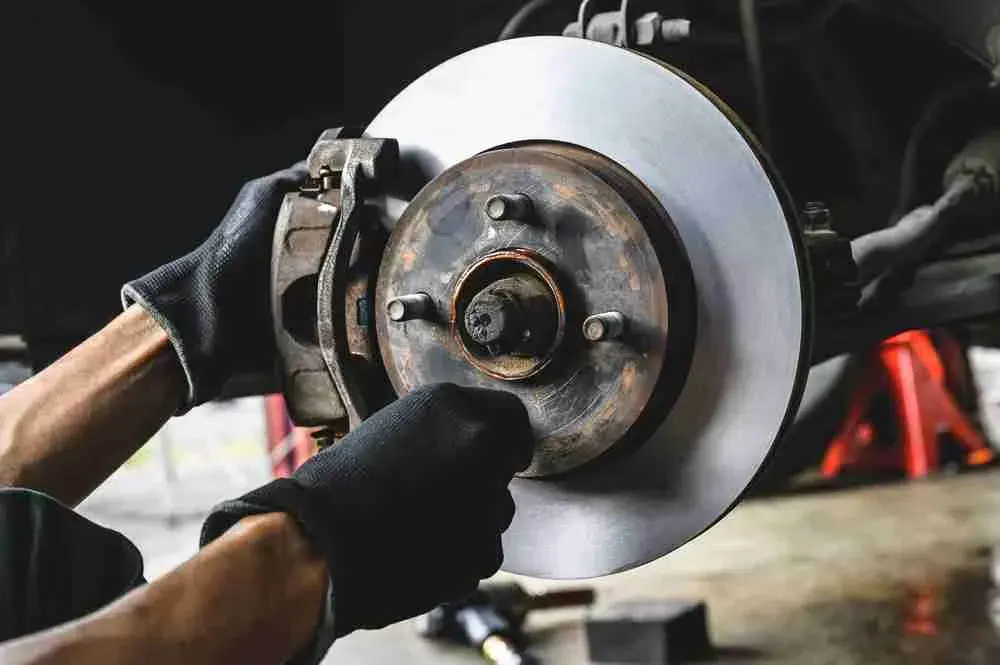
All four wheels come off so every rotor and pad can be seen and measured.
Step 2: Read the stamp
We find the minimum thickness figure on each rotor, and note it if rust has hidden it.
Step 3: Measure
Micrometer readings are taken at several points on each rotor, and pad thickness is measured too.
Step 4: Do the math
We compare the lowest reading with the stamp and calculate how much a resurfacing cut would leave.
Step 5: Report
You get a written result for each rotor: keep, resurface or replace.
What's included in a rotor thickness check
Included on the work order
- 01Micrometer readings at several points per rotor
- 02Minimum thickness figure read from each rotor
- 03Thickness variation noted
- 04Pad thickness measured on every wheel
- 05Keep, resurface or replace result for each rotor
- 06All readings written on the repair order
Need-now or need-later?
Need now: call
- Any rotor that measures at or below its stamped minimum
- A rotor that would fall below minimum once new pads wear it
Need later: book
- A rotor comfortably above minimum with slight thickness variation
- Healthy rotors worth rechecking at the next pad change
How pricing and timing work
Aftercare
Keep your repair order. The readings let us see how fast your rotors are wearing at the next visit. If measured rotors still shake, see brake rotor balancing.
Frequently asked questions
What is the minimum thickness for brake rotors?
It is different for every rotor. The figure is stamped or cast on the rotor itself, usually marked MIN TH. We read that number on your part and measure against it.
How do I check my brake pad thickness?
On many cars you can see the outer pad through the wheel. Compare the friction material with the steel plate behind it. If it looks close to the same thickness or thinner, have the pads measured soon.
Can a smooth rotor still be too thin?
Yes. Rotors wear evenly across the face, so only a micrometer reading tells you.