
On this page
Route 66 Auto Repair in Upland replaces brake rotors when measurement or damage says they are done: under the minimum thickness, cracked, heat-spotted or badly rusted. We show you the reading next to the spec and wait for your approval before new rotors go on. The rotor is the surface your pads squeeze, so it has to be flat, true and thick enough to soak up heat.
What makes a rotor unusable?
- Thickness at or under the minimum cast into the rotor
- Cracks running in from the edge or out from the cooling vents
- Blue or dark heat spots, often from long downhill braking
- Deep grooves from pads that wore into metal
- Heavy rust on the braking face, common on cars that sit
- Pulsation that comes back after resurfacing
Why do rotors wear out faster here?
Rotors turn motion into heat, and Inland Empire driving hands them plenty. A loaded SUV coming down the Cajon Pass, summer asphalt on Foothill Blvd, and stop-and-go on the I-10 all drive rotor temperature up. Repeated overheating changes the iron and leaves hard spots that wear unevenly, which is where much of the shake comes from.
Vented rotors have cooling fins between two faces. When rust or grit packs those vents, the rotor runs hotter still. That is one more thing we check once a rotor is off the car.
Heat is also why thickness is the deciding measurement. Nearly every rotor carries a discard figure cast or stamped into the hat or edge, often marked MIN TH, and a rotor at or under that figure is replaced rather than machined. Thinner iron absorbs less heat, so a rotor near its limit fades sooner on a long descent. We show you the micrometer reading beside the limit published for your vehicle, since that published limit, not a mileage estimate, is what decides.
Which replacement rotor fits your car?
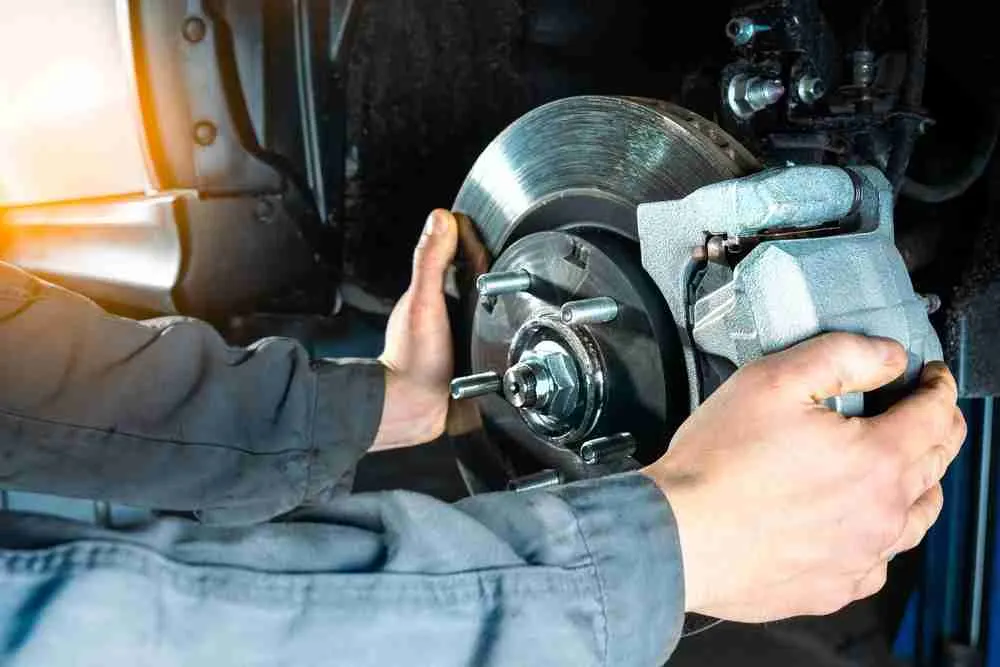
Standard rotors match the original design and suit most daily drivers. Coated rotors resist rust on the hat and vents, which helps cars that sit for long stretches. Drilled or slotted rotors look sporty, but on a street car they rarely stop better, and some types crack sooner. We recommend what matches your vehicle and how you use it, and your pick is written on the estimate.
Our rotor replacement steps
Step 1: Document
We photograph the old rotors and record thickness and damage.
Step 2: Prep the hub
Rust and scale are cleaned off the hub face so the new rotor sits perfectly flat.
Step 3: Install
The new rotor is cleaned of its protective oil, fitted, and checked for runout.
Step 4: Finish the axle
New pads go in with serviced hardware and everything is torqued to spec, then we road-test.
What's included in rotor replacement
Included on the work order
- 01Photos and readings of the old rotors
- 02Hub face cleaning
- 03New rotors of the type you approve
- 04Runout check after installation
- 05New pads matched to the rotors
- 06Road test
Do your rotors need replacing right away?
Need now: call
- A cracked rotor
- Deep scoring from pads that reached metal
- Thickness under the minimum
Need later: book
- Rust on the outer edge only
- Thickness above minimum with only mild pulsation
What affects rotor replacement price?
After new rotors go on
Treat the first few days as a break-in: smooth stops, and no hard braking from high speed unless you need it. We torque lug nuts in a star pattern. If anyone removes your wheels later, such as during tire service, ask for the lug nuts to be torqued to spec, since uneven tightening can bring pulsation back.
Frequently asked questions
Is it okay to put new pads on my old rotors?
Pads alone is fine when the rotors are above minimum, flat and smooth. Replace them together when the rotors are thin, damaged or causing a shake. We show you the reading so the call is yours.
Will you call me before adding rotors to my brake job?
Yes. If we find rotors that need replacing, we reach out with the reading and photos and wait for your approval. Nothing is added to the job without it.
Why are my new rotors rusty after a damp night?
Bare iron grows a thin film of surface rust very quickly. It wipes off in the first few stops. Rust that stays on the braking face after driving is a different matter and worth a look.