
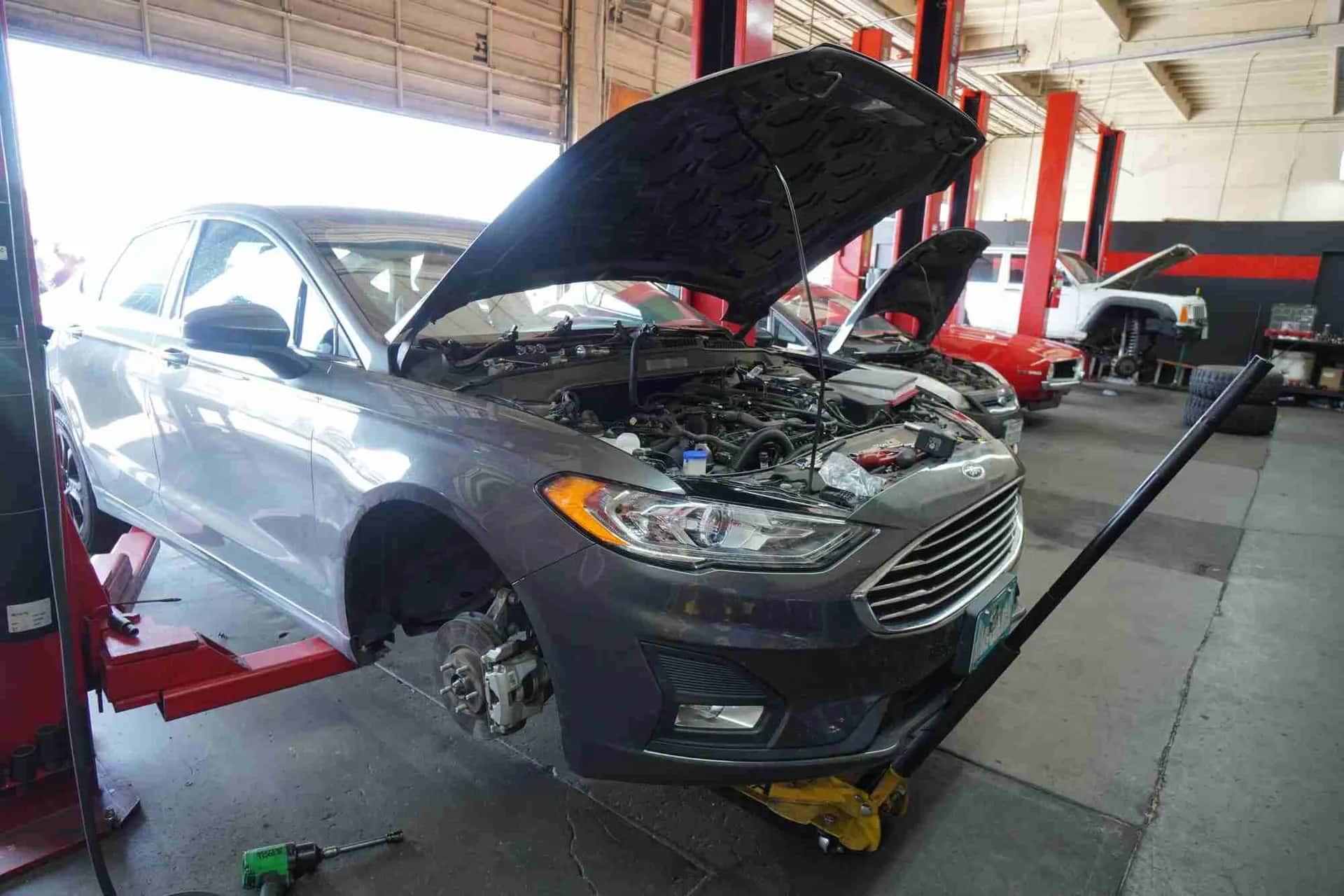
On this page
Brake disc is another name for a rotor, and on many cars swapping one takes a short time. Route 66 Auto Repair in Upland handles the harder cases too: discs rusted to the hub, discs held by seized retaining screws, rear discs with a parking brake drum inside, and discs that are pressed onto the hub itself. We measure the disc against its stamped minimum, tell you what makes your car harder or easier, and write it down first.
Why is disc replacement easy on one car and hard on another?
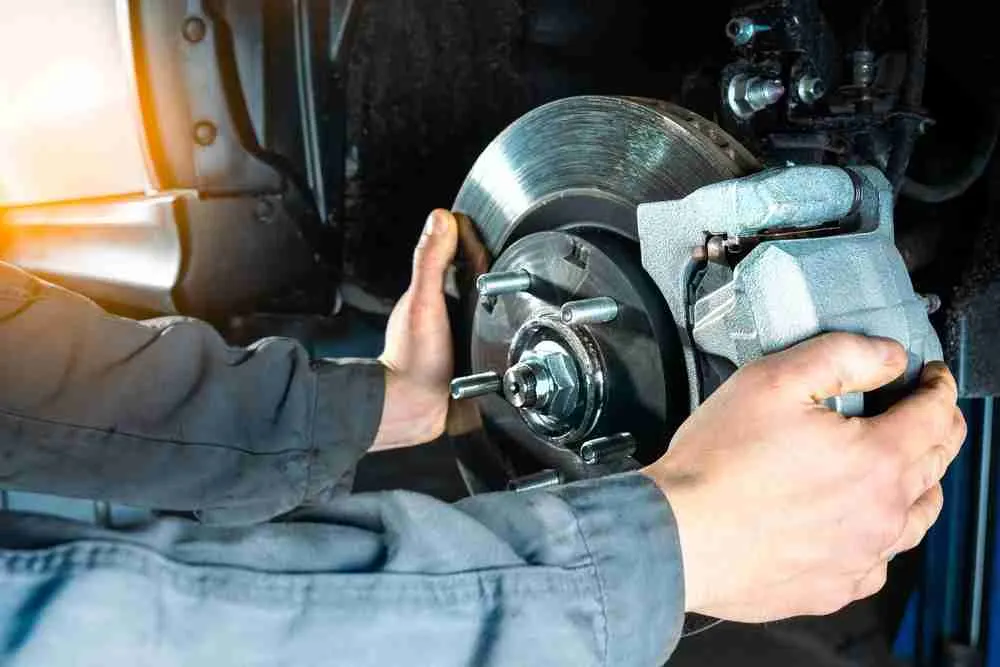
The easy design is a hat-shaped disc that slips over the wheel studs and is held in place only by the wheel. The hard designs take more time. Some discs are trapped behind the hub, so the hub and wheel bearing must come apart to change them. Some rear discs have a small parking brake drum cast inside, which means removing those shoes too. Many have a small retaining screw that rusts solid.
Heat also bonds the disc to the hub face. We free it without hammering on the bearing, and we clean the hub so the new disc sits flat.
Whatever the design, the same figure decides the outcome. Every disc carries a minimum thickness cast into it, usually marked MIN TH or DISCARD, and a disc measured at or below that figure is replaced rather than machined. Standard shop practice also leaves enough metal above that limit for the next set of pads to wear it down. The cast figure on your disc, and the limit in your vehicle maker's service data, are what we compare the micrometer reading against.
When does a disc need replacing?
- Measured thickness is at or under the minimum stamped on the disc
- Cracks running from the vents or bolt holes
- A deep lip at the outer edge that new pads would ride on
- Hard spots or blue heat marks from a long descent down the Cajon Pass
Our brake disc replacement process
Step 1: Identify the design
We check how your disc mounts and tell you up front if the hub or parking brake shoes must come apart.
Step 2: Measure
A micrometer reading is compared with the minimum thickness marked on the disc.
Step 3: Remove and clean
The old disc is freed, the hub face is cleaned to bare metal and checked for runout.
Step 4: Install
New discs go on in pairs with pads, and wheel nuts are torqued in sequence to spec.
Step 5: Bed and road-test
We bed the pads to the new discs and confirm a smooth, straight stop.
What's included in brake disc replacement
Included on the work order
- 01Disc thickness reading recorded before removal
- 02Mounting design explained before work starts
- 03Hub face cleaned and checked for runout
- 04New discs installed in axle pairs
- 05Caliper slides cleaned and lubricated
- 06Wheel nuts torqued in a star pattern
- 07Pad bedding and road test
Need-now or need-later?
Need now: call
- A disc under its minimum thickness
- A visible crack
- Pads worn through to the backing plate and cutting the disc
Need later: book
- A disc a little above minimum with pads that still have life
- Light surface rust on a car that is driven daily
What affects the price of disc replacement?
After new discs go on
Avoid hard stops for the first day of driving so the pads lay an even film on the discs. If a vibration shows up, compare notes with our brake rotor balancing page and call (909) 646-4111.
Frequently asked questions
Is a brake disc the same as a brake rotor?
Yes. The words mean the same part. Some makers and parts catalogs say disc, most American shops say rotor. Our brake rotor replacement page covers the choice of replacement parts.
Should I replace discs on both sides?
Yes. Axle pairs keep both wheels equal in thickness and heat capacity, so the car stops straight.
Why would the wheel bearing come apart to change a disc?
On some vehicles the disc is mounted behind the hub rather than over it. The hub has to come off to reach it, and the bearing is inspected or serviced at the same time.