
On this page
If your car clunks over driveway dips, drifts across the lane on the 210, or the steering wheel suddenly feels heavy or loose, Route 66 Auto Repair in Upland can track down the cause and repair it. Our ASE-certified (opens in a new tab) technicians put the car on a lift, check every joint for play, look for leaks and torn boots, and road-test it. You get a written estimate with each line marked need-now or need-later before a single bolt turns. We are at Foothill Blvd and Central Ave, one block east of In-N-Out Burger.
Clunks, pulls, bounce or a heavy wheel: what does each one mean?
Steering and suspension problems are unsettling because they change how the car answers you. The wheel that used to point straight now needs a constant nudge. A bump that used to disappear now thuds through the floor. Most of these feelings trace back to a small group of parts, and the table below shows where each symptom usually leads and how quickly it deserves attention.
Treat the table as a starting point, not a verdict. A pull can come from a tire, a dragging brake or a bent part, and the only honest way to separate them is to lift the car and test each joint by hand. That is what we do before any estimate is written.
| What you feel or hear | Where it usually comes from | Now or later? |
|---|---|---|
| Loose, vague steering or a wheel that wanders | Worn tie rod ends, inner tie rods or a steering rack with internal wear | Now. Steering play only grows, and a separated tie rod means lost control. |
| Clunk or pop over bumps and dips | Sway bar links, ball joints, control arm bushings or strut mounts | Soon. Links can often wait a short while; a loose ball joint cannot. |
| Car keeps bouncing after a dip | Worn shocks or struts that no longer control spring motion | Soon. Braking distance and stability suffer, especially when loaded. |
| Pulls to one side on a flat road | Tire pressure or wear, a bent part, worn bushings, or a dragging brake | Check soon. It often wears tires quickly while you wait. |
| Whine or groan when turning at low speed | Low or worn power steering fluid, a tired pump, or a leak | Soon. A pump run dry fails fast and can take the rack with it. |
| Hum or growl that rises with speed | A failing wheel hub bearing | Now if it grinds or the wheel has play; soon if it is a light hum. |
| Clicking when turning sharply | A worn outer CV joint on a front axle | Soon. A torn boot and clicking joint will eventually let go. |
| One corner sits lower than the others | A broken or sagging coil spring, or a failed strut | Now if the spring is broken; otherwise schedule it. |
How do we find the part that is actually worn?
We start where you felt the problem: on the road. A technician drives your car over the kind of dips, turns and lane changes that bring the symptom out, then writes down exactly when it happens. A clunk that only shows up in a slow, tight turn points somewhere different from a thump on the freeway.
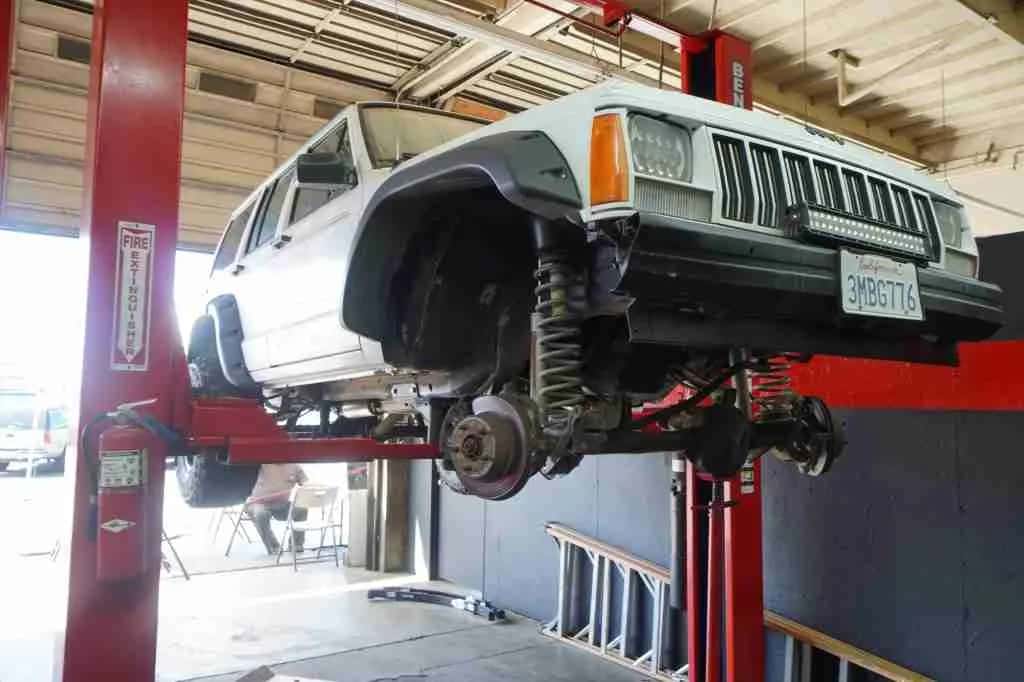
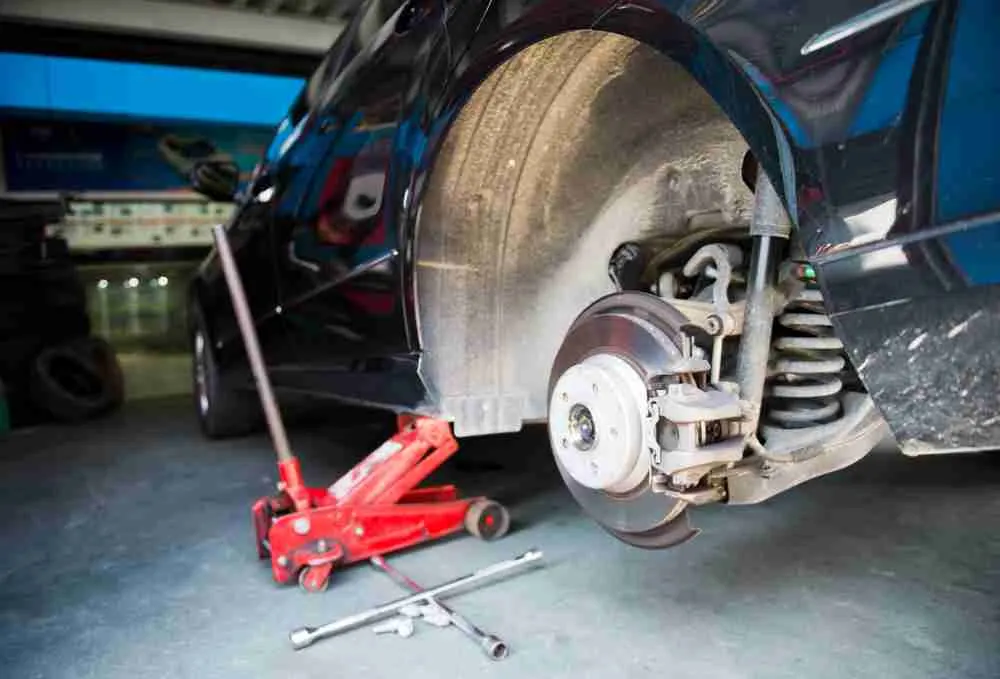
On the lift, the wheels hang free so the joints unload. The technician rocks each wheel top to bottom and side to side, watches for movement at the ball joints, tie rods and hub, and uses a pry bar to check bushings for tearing. We look for oily shocks and struts, cracked springs, split CV boots and seeping power steering hoses. Worn parts get photographed so you can see what we saw.
We also read your tires. Edge wear, cupping and feathering each tell a story about which angle or part is off. If the tread already shows the damage, our tire wear analysis notes it on the repair order so the fix addresses the cause, not just the rubber.
Do you do wheel alignments at Route 66 Auto Repair?
We do not align wheels in-house, and we would rather tell you that up front. What we do is the part that makes an alignment worth paying for. We inspect tire wear and the suspension parts that hold the angles, repair anything loose or bent with your approval, then arrange the alignment and road-test the car when it comes back. An alignment on worn tie rods or tired bushings drifts out again within weeks, so the inspection comes first.
If your tires show edge wear or the car will not track straight, start with our suspension alignment page. It explains camber, toe and caster in plain words and shows how we coordinate the job so you are not running between shops guessing which one caused the problem.
Hydraulic or electric power steering: why does it matter?
Older and many truck-based vehicles use hydraulic power steering. An engine-driven pump pushes fluid through hoses to the rack or gearbox, and that pressure does the heavy lifting when you turn. These systems talk to you: a whine at full lock, a groan in parking lots, or a damp spot under the front of the car. Fluid condition matters, and leaks matter more.
Many newer cars use electric power steering, with a motor on the column or rack and no fluid at all. When it fails, a warning light usually comes on and the wheel turns heavy. Those faults start with a scan and a voltage check rather than a fluid check. Either way, our power steering repair work begins by confirming which system your car has, so nobody sells you a fluid flush a motor-driven rack does not use.
Why do Inland Empire roads wear suspension parts faster?
Heat is the quiet one. Summer pavement in Upland bakes rubber bushings, boots and strut mounts, and rubber that has cooked for a few seasons cracks sooner. Shocks and struts run hotter too, and the oil inside thins and foams under repeated hard work.
Then there are the roads themselves. Stop-and-go on Foothill Blvd, speed humps in residential streets north of the boulevard, steep driveways, and patched lanes on the 10 all load the same joints over and over. Heavy loads up the Cajon Pass stress springs and dampers. Short-trip commuters and work trucks both feel it, just in different places. None of this means your car is fragile. It means a yearly look at the front end catches wear before it chews through a set of tires.
Our suspension and steering repair process
Step 1: Tell us what you feel
At the counter we write down the noise, pull or looseness, when it happens and how long it has been going on. You choose wait or drop-off at intake.
Step 2: Road test to reproduce it
A technician drives the car on real streets to confirm the symptom before anything is taken apart.
Step 3: Lift inspection
Each joint, bushing, damper, spring, boot and hose is checked for play, leaks and damage. Tire wear patterns are recorded.
Step 4: Photos and written estimate
You see photos of the worn parts and a written estimate with every line labeled need-now or need-later. The diagnostic fee is stated at the counter before testing and applies to approved related repair.
Step 5: Repair to spec
Approved parts are installed and torqued to the manufacturer's values, with suspension bolts tightened at ride height where the design calls for it. If the job grows, we stop and ask again.
Step 6: Alignment and road test
When the repair changes steering angles, we arrange the alignment, then road-test the car to confirm it tracks straight and the noise is gone.
What's included in a suspension and steering repair
Included on the work order
- 01Road test before the inspection and again after the repair
- 02Play check at ball joints, tie rods, hubs and control arm bushings
- 03Shock, strut, spring and mount condition check
- 04Power steering fluid, hose and leak check on hydraulic systems
- 05CV boot and axle inspection on front-drive and all-wheel-drive cars
- 06Tire wear pattern noted on the repair order
- 07Photos of worn or failed parts, with old parts available to see
- 08Written estimate with need-now and need-later labels
Which steering and suspension repairs are need-now and which can wait?
Need now: call
- Measurable play in a ball joint, tie rod end or wheel hub
- A broken coil spring or a strut that has lost its mount
- A power steering leak that drops the fluid level between fill-ups
- A torn CV boot with a joint that already clicks or clunks
Need later: book
- Shocks or struts that are weakening but not leaking or broken
- Sway bar links with slight looseness and no rattle yet
- Cracked but intact bushings, noted so you can plan for them
- Power steering fluid that is dark but still at the correct level
How do pricing and timing work for suspension and steering work?
We do not give a flat suspension price over the phone, because a clunk can be a small link or a control arm, and the car decides which. Phone quotes are ranges until the vehicle is inspected. What moves the price: the vehicle and its design, whether parts come as complete assemblies or separate pieces, rusted or seized hardware, whether the repair changes steering angles and needs an alignment, and the parts grade you choose. Your written estimate shows every step before work begins.
Many single-part jobs, like sway bar links or a tie rod end, can often be done the same day when the board allows, so call (909) 646-4111 before you drive over. Steering racks, differential work and jobs that need an alignment take longer. We give you a realistic window and text you if it will slip. If two technicians are needed on one job, we explain that before the clock starts.
What should you expect after suspension or steering repair?
The first drive often feels different, and that is usually good. New struts can feel firmer, and fresh tie rods remove play you had stopped noticing. Give yourself a few miles to get used to it. If the steering wheel sits off-center or the car drifts after parts that affect angles were replaced, make sure the alignment we arranged has been completed; do not skip it.
Watch your tires for the next few weeks. Even wear across the tread is the sign the repair worked. If a clunk returns, a new noise appears, or you spot fluid under the car, call us. Comebacks go to the front of the line, and the root cause is written on the repair order. Declined items stay on your repair order too, so the next visit starts with the history in hand.
Every suspension and steering services page
Each page explains the symptoms, how we test, what the work order includes and what to ask before you approve.
- Suspension and Steering Overview
- Suspension Repair
- Suspension Alignment
- Power Steering Service
- Power Steering Repair
- Steering Rack Replacement
- Ball Joint Replacement
- Tie Rod End Repair
- Sway Bar Link Repair
- Coil Spring Replacement
- Suspension Bushing Repair
- Shock Absorber Replacement
- Strut Repair
- Control Arm Replacement
- Wheel Hub Assembly Repair
- Chassis Repair
- Differential Repair
- Axle Repair
Frequently asked questions
Why does my car pull to one side?
The usual suspects are tire pressure, uneven tire wear, a worn or bent suspension part, or a brake that is dragging. We check pressures and tread, test every joint on the lift, and look at the brakes before blaming the alignment. If an alignment is needed, we arrange it after the worn parts are fixed.
How do I know my struts are worn?
Common signs are extra bounce after dips, the nose diving hard when you brake, body sway in turns, oily residue on the strut body, and cupped tire wear. A bounce test in a parking lot is a clue, not proof. On the lift we look for leaks, damaged mounts and worn tops.
What does a clunk over bumps mean?
Most clunks come from something loose: a sway bar link, a ball joint, a control arm bushing or a strut mount. Some are harmless for now and some are not. We reproduce the noise on a road test, then find the loose part on the lift and show you a photo before you decide.
Why does my steering groan at full lock?
On hydraulic systems, a groan or whine when you turn the wheel all the way usually means low fluid, air in the system, or a pump that is wearing out. Holding the wheel at full lock for long also strains the pump. We check the fluid level and condition first, then trace any leak.
Can an alignment fix a worn tie rod?
No. An alignment sets the angles, but a worn tie rod lets the wheel move after the adjustment, so the setting will not hold and the tires keep wearing. The tie rod has to be replaced first. Then we arrange the alignment and road-test the car.
How is an alignment problem found?
Tires usually tell us first. Edge wear, feathering and a steering wheel that sits crooked on a straight road all point to angles that are off. We inspect the tire wear and the parts that hold the angles, repair anything worn, then arrange the alignment and confirm the result on a road test.
Is it safe to keep driving with a clunking front end?
Sometimes, but you should not guess. A worn sway bar link is noisy but rarely dangerous. A loose ball joint or tie rod can separate and cost you steering. If the wheel feels loose or the noise is getting worse, keep trips short and call us at (909) 646-4111.
Do you work on trucks and SUVs?
Yes. Pickups, SUVs, vans and work trucks come through our bays regularly, including leaf spring rear ends, solid axles and heavier steering parts. Diesel trucks are welcome too. Tell us at intake if the truck tows or hauls, because that changes which parts we pay closest attention to.