

On this page
Your AC has pressure switches or sensors that act as safety guards. They stop the compressor when pressure is too low or too high. Route 66 Auto Repair in Upland tests those switches when the compressor will not engage, cycles too often, or the fans behave oddly. A bad switch can make a full system look empty, so we compare its reading against our gauges before we replace it.
What does an AC pressure switch do?
Older systems use simple on-off switches. A low pressure switch opens if the charge drops too far, protecting the compressor from running without oil flow. A high pressure switch opens if pressure spikes, often from a failed fan. Many newer cars use a single pressure sensor, called a transducer, that sends a live reading to the engine computer. The computer uses it to run the compressor and, on many vehicles, the cooling fan speed.
What are the signs of a bad pressure switch?
- Compressor never engages even though gauges show a normal charge
- Compressor clicks on and off every few seconds
- Cooling fans run at high speed all the time, or not at all with AC on
- A pressure sensor trouble code in the engine computer
- Refrigerant oil or dye at the switch base, a sign of a leaking seal
How do we test the switch?
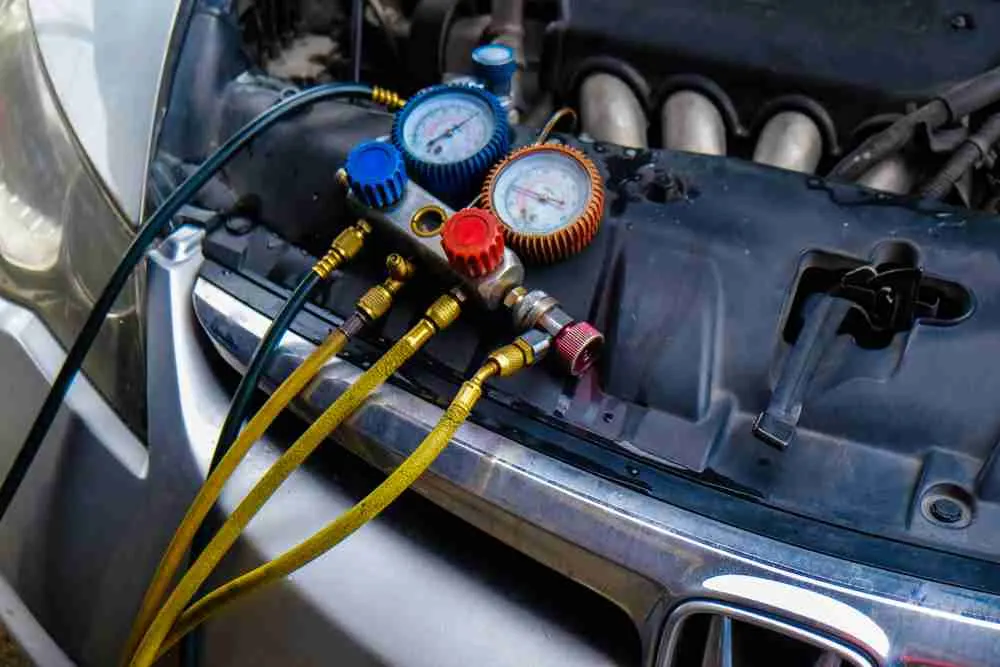
With gauges connected, we read the actual high side pressure, then look at what the sensor reports on the scan tool. If gauges read a normal value and the sensor reads zero or maximum, the sensor or its wiring is lying. We back-probe the connector for reference voltage, ground and signal to tell which. A switch that tests fine means the problem is elsewhere, usually a real low charge that needs leak detection.
Many switches thread onto a valve so they can be replaced without losing refrigerant. Others seal directly into the line, and the system must be recovered first. We check your car before quoting.
Our switch replacement process
Step 1: Compare readings
Gauge pressure and sensor signal are compared side by side.
Step 2: Check the wiring
Reference, ground and signal are verified at the connector.
Step 3: Replace the switch
The switch gets a new O-ring and correct oil, with recovery first if the port has no valve.
Step 4: Confirm control
We watch compressor and fan behavior at idle and on a road test.
What's included in pressure switch replacement
Included on the work order
- 01Gauge versus sensor comparison
- 02Connector and wiring test
- 03Pressure switch or transducer
- 04New sealing O-ring
- 05Recovery and recharge when required
- 06Compressor and fan operation check
How pricing and timing work
A switch on a valved port is usually a quick job. One that needs refrigerant recovery adds a recharge line to the estimate. Wiring repairs are priced after the fault is found, and a full AC pressure test is included when the readings need a second look. Most switch jobs finish the same day when the board allows. If the fan misbehaves too, see condenser fan repair.
Frequently asked questions
Can I jump the pressure switch to test the AC?
Jumping a switch bypasses the safety that protects your compressor. If the system is truly low, the compressor can run without oil flow and fail. Let us read the pressure first.
Is a pressure switch the same as a pressure sensor?
They do the same job in different ways. A switch is on or off. A sensor sends a changing signal to the computer. Your vehicle uses one, the other, or both.
Does a bad switch cause overheating?
On cars where the pressure sensor controls fan speed, a failed sensor can leave the fan too slow in traffic. That can raise engine temperature as well as AC pressure.