

On this page
An AC system recharge at Route 66 Auto Repair in Upland is a machine procedure, not a quick top-off. We recover what is left, pull a deep vacuum to boil off moisture, check that the system holds, and charge the exact weight printed on your underhood label. Then we measure vent temperature on a road test. This page walks through each step and what shows on your invoice.
What happens before a recharge?
We confirm the system is sealed. If you have not had a leak check, we start there, because a recharge on a leaking system only lasts until the refrigerant escapes again. Our refrigerant recharge page explains why systems go low in the first place. We also ask whether a parts-store can was used, since sealer changes how we connect equipment.
Two figures shape the job itself. An AC system is charged by weight, not by feel, and the label under your hood states that weight to the ounce; a system a few ounces off in either direction cools poorly. Before the charge goes in, standard practice pulls the system into a deep vacuum, commonly in the neighborhood of 29 inches of mercury, and holds it to prove the system is dry and sealed. The label on your vehicle and the maker's procedure are what we follow.
Why does each recharge step matter?
Recovery
The machine pulls out the remaining refrigerant, filters it and weighs it. The weight tells us how far below spec the system was, which hints at how fast it is leaking.
Vacuum
A vacuum pump lowers the pressure inside the system until any moisture boils away. Moisture mixed with refrigerant oil forms acid and can freeze in the expansion valve. We hold the vacuum and watch for a rise, which would mean air is getting in.
Oil and charge
Oil lost with the old refrigerant is replaced with the type your compressor uses. Then the machine meters in the exact refrigerant weight listed for your vehicle. Weight is used because pressure alone changes with the weather.
Verification
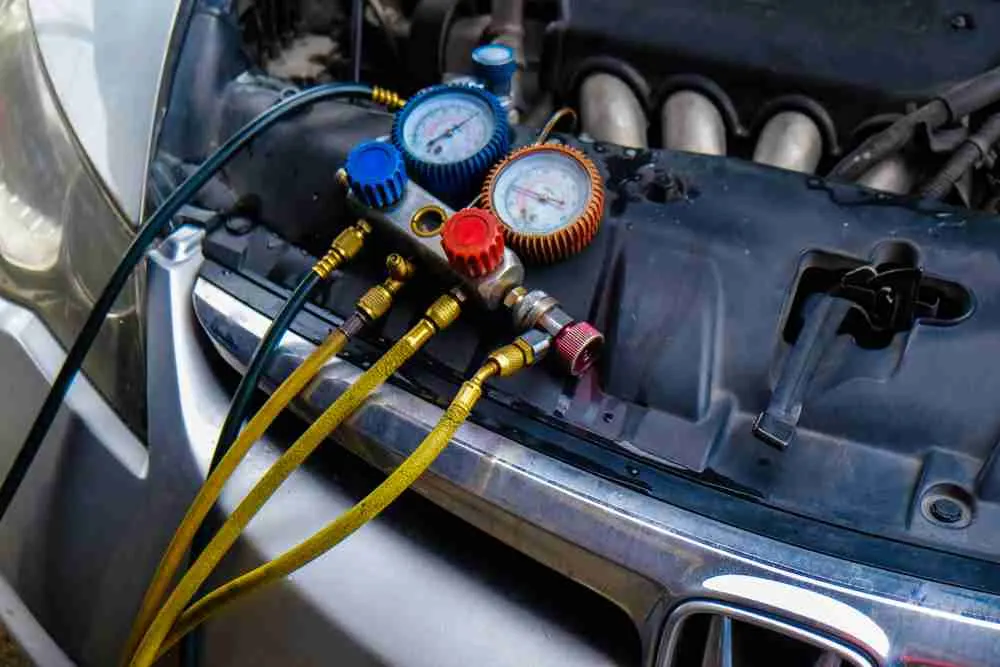
With the engine running and doors closed, we record high and low side pressures and the center vent temperature, then road test. If cooling is still weak, the next step is car AC repair.
Our AC recharge procedure
Step 1: Leak check
We confirm there is no active leak or get your decision in writing if there is.
Step 2: Recover and weigh
The remaining charge is removed and weighed.
Step 3: Vacuum and hold
A deep vacuum is pulled and held to prove the system is tight and dry.
Step 4: Charge and verify
Oil and the specified refrigerant weight go in, then pressures and vent temperature are recorded.
What's included in an AC system recharge
Included on the work order
- 01Refrigerant recovery and weighing
- 02Vacuum and vacuum hold test
- 03Replacement oil for the compressor type
- 04The refrigerant your vehicle specifies, by label weight
- 05Optional UV dye for future leak checks
- 06Pressure readings and vent temperature on the repair order
How pricing and timing work
Frequently asked questions
How long does an AC recharge take?
The machine steps usually take about an hour, including the vacuum hold. Leak testing or repairs add time, and we give you the look window at intake.
Why not charge until the gauge looks right?
Pressure changes with outside temperature and humidity, so it is a poor way to judge amount. Charging by weight to the label spec is accurate in any weather.
Will you add dye during the recharge?
We recommend it if the system was low. It costs little and makes any future leak much faster to find.