
On this page
Route 66 Auto Repair in Upland replaces worn bearings inside manual gearboxes. Bearing noise has a signature: a whine or growl that changes when you press the clutch, shift gears, or go from accelerating to coasting. The tricky part is that release bearings, wheel bearings and tires can sound similar. We sort out which one it is before the gearbox comes out, then give you a written estimate for the job.
How do we tell which bearing is noisy?
Each test changes which parts are spinning, and the noise follows the part that is worn:
- Noise in neutral, clutch out, that stops when you press the pedal: often the input shaft bearing or countershaft bearings, which stop turning when the clutch is released.
- Noise only with the pedal pressed: usually the clutch release bearing, not the gearbox.
- Noise in every gear that grows with road speed: output shaft bearing, or a wheel bearing outside the gearbox.
- Noise in one gear only: that gear's needle bearing or gear teeth.
- Noise that changes when you turn: almost always a wheel bearing or tire.
Why do gearbox bearings wear out?
Low gear oil is the common cause, often from a slow leak at a seal. The wrong oil is another. Towing, heavy loads and high mileage add up too. Once a bearing wears, the shaft it supports can move, which wears the gears and synchronizers next to it. That is why a growl caught early usually costs less than one ignored until a gear starts slipping out.
Our gearbox bearing replacement process
Step 1: Isolate the noise
We run the pedal, gear and coast tests on a road test and on the lift.
Step 2: Check the oil
Level, type and any metal on the drain plug magnet tell us how far wear has gone.
Step 3: Remove and inspect
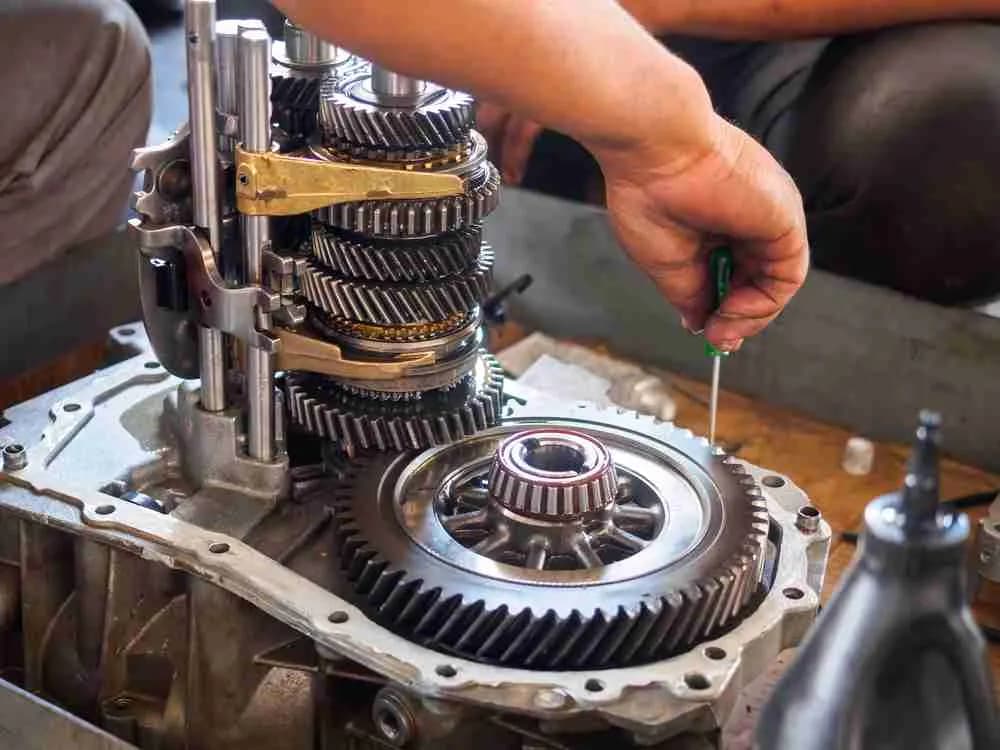
The gearbox comes out and the bearings, shafts and gears are checked.
Step 4: Replace and reseal
Worn bearings and nearby seals are replaced to spec, and the gearbox is refilled.
What's included in gearbox bearing replacement
Included on the work order
- 01Noise isolation tests
- 02Gear oil drain and magnet check
- 03Gearbox removal and installation
- 04Replacement bearings and affected seals
- 05Refill with the specified gear oil and a road test
Need-now or need-later?
Need now: call
- A growl that is getting louder quickly
- Metal chunks on the drain plug
Need later: book
- A faint whine in neutral with clean oil, rechecked at the next service
How pricing and timing work
Aftercare
Check under the car for drips at the gearbox for a week. Have the gear oil level checked at your next oil change, since low oil is what wears bearings in the first place.
Frequently asked questions
Can I add gear oil to quiet a noisy bearing?
If the level is low, filling it to spec is the right first step, and it may slow wear. It will not repair a bearing that is already damaged.
How long can I drive with a noisy gearbox bearing?
It varies. A steady faint whine may last a while. A growl that gets louder, or any grinding, needs attention soon, because a failed bearing damages the gears around it.
Is it the gearbox or the clutch making the noise?
The pedal test usually tells. Noise that starts when you press the pedal points to the release bearing. Noise that stops when you press it points into the gearbox.